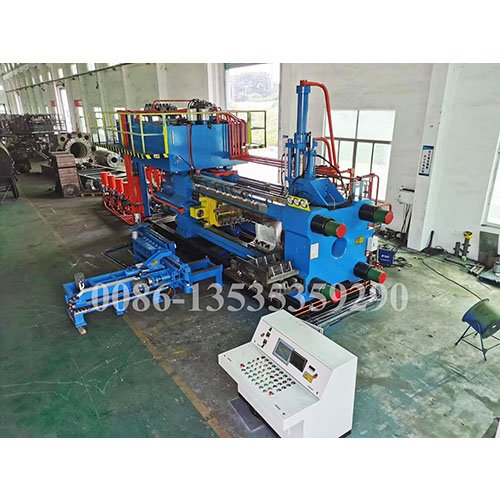
Key Factors Affecting Extrusion Force Required/aluminum extrusion press capacity choosing
Key Factors Affecting Extrusion Force Required/aluminum extrusion press capacity choosing
- Properties of the aluminum alloybeing extruded: The higher the yield strength of the aluminum alloy, the greater the resistance to deformation, the higher extrusion force is required; conversely, better plasticity requires lower extrusion force. Based on these properties, aluminum alloys are classified as 3 types: easy-to-extrude, standard, difficult-to-extrude.
- Extruding temperature: The temperatures of the billet, billet container, and tooling are one of the major factors influencing extrusion force; the extrusion force decreases as temperature rises. When extruding difficult-to-deform alloys, the container and tooling temperatures should be set to the upper limit, and pay attention to temperature holding during the
- Extruding speed: the higher the extrusion speeds is, the greater extrusion force is required.
- Degree of deformation: the bigger the extrusion ratiois, the greater extrusion force is required.
- Die mold: Die structure, die orifice distribution, bearing length, and tool surface condition all affect extrusion force. The die angle (α) has a significant impact; conical dies require less extruding force than flat dies. As the die angle increases from 0° to 90°, the extrusion force is lowest within the 45°–60° range. Force increases when using tongue dies, flat composite dies, stepped-section dies, or width spreading dies due to the metal undergoing dual deformations. Extruding flat, wide profiles using a rugby shaped hole container significantly reduces the required force compared to using a round hole container. Single cavity extrusion requires more force than multi cavities extrusion, and symmetrically distributed die holes require less force than asymmetrical arrangements.
- Profile/extrusion shape and dimensions: The more complex and asymmetrical the product shape, the greater the required extrusion force. The width-to-thickness ratio of the profile is also a critical factor; for profiles (especially panel profiles), greater width and thinner walls increase the required force. When the width-to-thickness ratio exceeds 50, the extrusion force increases by more than 20%.
- Aluminum billet shape, dimensions, and surface condition: Larger billetdiameters and longer lengths require higher extrusion forces; however, the cross-sectional area of the billet has a more significant impact on extrusion force required than the length does. When using indirect extrusion, lubricated extrusion, or hydro-static extrusion, the billet length has virtually no effect on the extrusion force. The greater the geometric similarity between the billet and the extruded profile, the lower the required extrusion force. Using homogenized billet can significantly reduce the required extrusion force—by more than 25% for some aluminum alloys.
We provide aluminum extrusion press from 4 inches to 20 inches capacity. Please feel free to contact us: +8613535359290. Mr. Don Tang.